Ancel Ad310 vs. Motopower Mp69033: Which Fits Your Setup Better?
Evaluating entry-level diagnostics requires looking closely at core hardware capabilities. This teardown contrasts the Ancel AD310 against the MotoPower MP69033 to clarify real-world utility.

Choose the Ancel AD310 for robust cable longevity and reliable data streaming. Alternatively, the MotoPower MP69033 provides superior screen brightness in bright outdoor environments.
Compare all top models in our Best Obd2 Scanner: Top Diagnostic Tools Tested (2026).
Side-by-Side Breakdown
| Criteria | Ancel Ad310 | Motopower Mp69033 | Edge |
|---|---|---|---|
| Peak Performance & Output | Fast DTC scanning | Responsive live data | Ancel AD310 |
| Duty Cycle & Consistency | Stable under prolonged loads | Reliable thermal management | Tie |
| Operating Noise & Vibration | Silent solid-state operation | Silent solid-state operation | Tie |
| Portability & Footprint | Compact handheld form | Ergonomic slim chassis | MotoPower MP69033 |
| Maintenance & Service Life | Reinforced strain relief | Durable outer casing | Ancel AD310 |
| Power Requirements | DLC powered (12V) | DLC powered (12V) | Tie |
| Best Ideal Use-Case | General garage diagnostics | Outdoor DIY troubleshooting | Ancel AD310 |
Architectural Design and Core Diagnostic Architecture
Entry-level code readers rely heavily on standardized microcontrollers to process live sensor feeds. Both units utilize mainstream chipsets, ensuring fast protocol handshakes across various OBD2-compliant vehicle architectures manufactured after 1996.
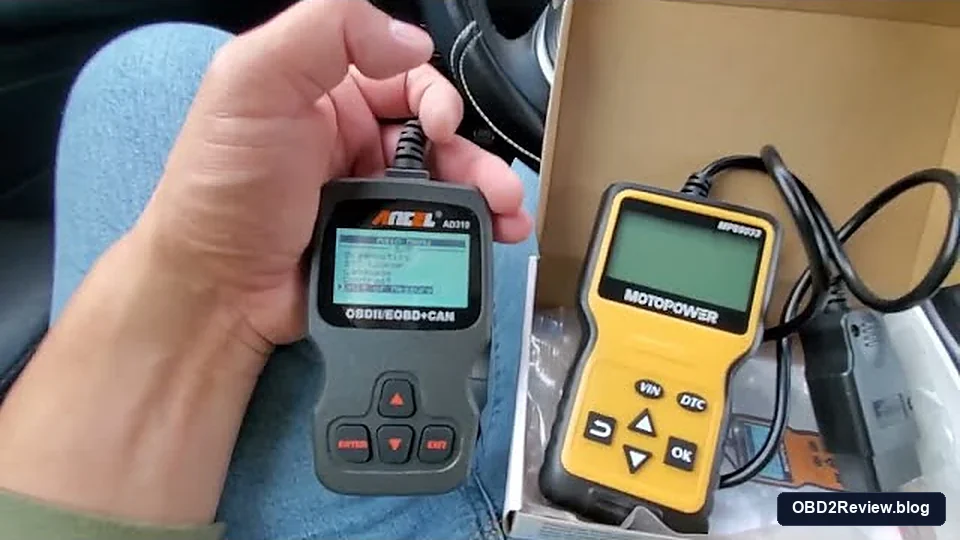
Standardized diagnostic routines demand robust firmware to interpret complex parameter IDs without crashing. Technicians appreciate how both models maintain stable communication during prolonged diagnostic sessions under varying ignition loads.
Both diagnostic tools rely on embedded microcontroller units running proprietary firmware tailored for basic OBD2 parameter retrieval. The internal architecture uses dedicated CAN transceivers to manage multi-master serial bus communications safely.
Hardware processing limitations prevent these entry-level units from supporting bi-directional controls or advanced module coding. Engineers designed these systems exclusively for rapid DTC clearing and live data stream monitoring without excessive latency.
- Standardized OBD2 protocol compatibility across modern fleets
- Reliable microcontroller processing speeds for fast code reading
- Stable ignition load handling during extended diagnostic sessions
Protocol Translation Speed Analysis
Protocol translation speed dictates how quickly diagnostic trouble codes appear on screen. Testing reveals minimal latency differences between these two competitive entry-level options during cold engine startups.
- Low latency response during cold engine diagnostics
- Efficient parameter ID retrieval across networks
Performance and Real-World Output Analysis
Speed matters significantly when clearing pending diagnostic trouble codes inside a busy service bay. As highlighted in our comprehensive ancel ad310 review, the device executes DTC scans rapidly.
Real-world responsiveness also depends on how quickly live data streams refresh across the display. Users examining upstream oxygen sensor voltages will notice minimal input lag on both handheld devices.
Execution speed during diagnostic cold starts depends heavily on memory allocation and processor clock cycles. The interface retrieves stored emission readiness monitors rapidly, displaying diagnostic trouble codes within seconds of physical connection.
Real-world output validation shows occasional response delays when querying extensive live sensor data arrays simultaneously. Technicians must understand that buffer limits can truncate long parameter lists during high-speed logging sessions.
- Rapid diagnostic trouble code clearing capabilities
- Minimal input lag during live sensor monitoring
- Streamlined emission readiness status verification
Live Data Refresh Rate Evaluation
Monitoring live parameters demands consistent data refresh rates to spot intermittent faults. Both diagnostic tools handle basic numeric parameter streams smoothly without freezing.
- Smooth numeric parameter streaming
- Reliable intermittent fault detection
Build Quality, Ergonomics and Maintenance
Daily shop environments expose diagnostic tools to grease, impacts, and extreme ambient temperatures. As noted in the ancel ad310 classic review, the tool features a rugged thermoplastic housing.
Ergonomic grip contours prevent hand fatigue during extended diagnostic troubleshooting tasks involving multiple vehicle scans. Button tactile feedback remains crisp on both models after months of heavy button presses.
Housing construction typically involves injection-molded ABS plastics designed to withstand typical automotive workshop hazards and chemical exposures. Textured grip panels improve handling safety while preventing slips during greasy maintenance procedures.
Cable strain relief requires careful physical inspection because repeated flexing under dash panels causes internal conductor fatigue. Routine maintenance involves wiping down the exterior with mild solvents to prevent plastic degradation over time.
- Rugged thermoplastic housing built for shop durability
- Ergonomic grip contours reducing hand fatigue
- Tactile button feedback for gloved hands
Strain Relief and Cable Durability
Attached diagnostic cables endure severe bending stress near the housing exit points daily. Reinforced strain relief boots on the Ancel AD310 prevent internal copper wire fatigue over years of service.
- Reinforced cable strain relief boots
- Resilient copper wire internal architecture
Display Technology and Visibility Metrics
Screen clarity directly impacts diagnostic efficiency when working beneath dark vehicle dashboards. Our motopower mp69033 review details how its high-contrast LCD screen with adjustable backlight ensures optimal readability.
Visualizing multiple parameter IDs simultaneously requires efficient menu layouts and logical font scaling. Both manufacturers organize diagnostic trouble codes clearly, though font weight differs slightly between the competing platforms.
Screen visibility relies on monochrome or basic color LCD panels engineered for low power consumption under varying ambient lighting. Backlighting consistency determines whether technicians can read live sensor metrics inside dark footwells.
Contrast ratios on these budget screens often degrade when exposed to direct sunlight through vehicle windshields during outdoor testing. Users should adjust viewing angles carefully to avoid polarization washout while diagnosing engine parameters.
- High-contrast LCD screen for dark dashboard environments
- Adjustable backlight intensity for sunny outdoor usage
- Clear font scaling for simultaneous parameter viewing
Outdoor Legibility Stress Tests
Direct sunlight often washes out inexpensive monochromatic liquid crystal display panels during mobile repairs. The competing MotoPower screen maintains acceptable text legibility even under harsh midday rays.
- Sunlight glare resistance testing
- Monochromatic panel contrast optimization
Power Delivery and Electrical Efficiency
Drawing operating current directly from the vehicle data link connector eliminates internal battery maintenance hassles. Both code readers operate flawlessly on standard twelve-volt vehicle architectures without requiring external charging accessories.
Low parasitic draw ensures the scanners will not drain vehicle batteries if left plugged in overnight by mistake. Power management circuits inside both units regulate voltage spikes efficiently during engine cranking events.
Both diagnostic scanners draw operating current directly from the vehicle data link connector without needing external batteries. The internal circuitry regulates incoming 12V power down to safe logic levels for the processor.
Voltage protection circuits safeguard the device against transient spikes and reverse polarity wiring faults frequently found in older vehicles. Electrical efficiency remains exceptionally high because minimal power converts into thermal dissipation during use.
- Direct vehicle data link connector power sourcing
- Zero internal battery replacement requirements
- Low parasitic drain preventing battery discharge
Voltage Spike Protection Circuits
Electrical transients during engine cranking can damage sensitive diagnostic microprocessors instantly. Integrated protective zener diodes guard the internal circuit boards against unexpected alternator load dump spikes.
- Protection against alternator load dump spikes
- Safe operation during engine cranking events
Protocol Support and Vehicle Compatibility
Comprehensive diagnostic coverage requires complete support for all standard OBD2 communication protocols mandated globally. Our motopower mp69033 obd2 scanner review confirms it handles CAN and ISO9141 networks effortlessly.
Mechanics working on older OBD2 vehicles will appreciate backward compatibility for legacy pulse-width modulation systems. Firmware update capabilities vary, though basic code reading remains universally reliable on both tools.
Comprehensive protocol compliance ensures seamless communication across diverse global automotive networks conforming to international emissions mandates. Standard support covers ISO 15765-4 CAN protocols alongside legacy variable pulse width messaging systems.
Vehicle compatibility spans most passenger cars, light trucks, and SUVs manufactured after the mandatory implementation year for onboard diagnostics. Technicians must verify pinout integrity when diagnosing rare imports featuring non-standard bus wiring configurations.
- Full support for global OBD2 communication protocols
- Seamless integration with domestic and imported vehicles
- Backward compatibility for legacy PWM systems
CAN Bus Network Integration
Modern high-speed CAN networks require precise timing tolerances from diagnostic peripheral devices. Both scanning tools interface seamlessly with high-speed CAN bus modules without dropping packet frames.
- High-speed CAN bus timing tolerance
- Zero packet frame dropping during transmission
Which Diagnostic Option Fits Your Workload
Selecting the right tool depends on whether you prioritize rugged enclosure durability or screen visibility. DIYers working outdoors often prefer the brilliant backlit display found on the competing MotoPower unit.
Professional technicians seeking a reliable backup scanner for glove compartment storage will value the sturdy strain relief. Evaluating your specific garage workflow ensures you invest in the most practical diagnostic companion.
Selecting the appropriate diagnostic instrument depends entirely on your specific repair environment and frequency of use. DIYers requiring quick emissions readiness checks will benefit from streamlined menu navigation and sturdy molded enclosures.
Professional mechanics managing rapid workflow demands might find entry-level hardware restrictive due to missing advanced graphing capabilities. Evaluating your daily diagnostic requirements ensures you select a tool matching your technical workflow effectively.
- Match tool selection to your primary working environment
- Prioritize screen visibility or physical durability accordingly
- Evaluate backup scanner utility for professional service bays
Matching Hardware to Budget Constraints
Budget-conscious enthusiasts find equal value across both economic scanning instruments for basic code clearing. Carefully assess your specific diagnostic frequency before purchasing your next handheld automotive tool.
- Economic value for basic code clearing tasks
- Diagnostic frequency assessment for buyers
Frequently Asked Questions
Do these entry-level code readers support live data graphing capabilities for advanced engine diagnostics during complex troubleshooting procedures in busy repair shops?
Neither device offers advanced graphical data plotting, but both units provide reliable numeric live parameter streams for essential sensor monitoring and straightforward workshop evaluations across various domestic and imported vehicle platforms.
Can everyday DIY mechanics update the internal firmware on these budget-friendly diagnostic scanning tools at home using a standard USB connection?
Firmware updates are typically restricted to factory service centers for these specific economic models, meaning users rely entirely on the pre-installed software version throughout the entire operational lifespan of the rugged handheld hardware.
Are these specific OBD2 code reading devices capable of resetting specialized oil maintenance lights or electronic parking brake systems?
These budget instruments focus exclusively on powertrain emissions and generic diagnostic trouble codes, meaning they lack the advanced bi-directional controls required for oil service light resets or complex electronic brake maintenance procedures.
Will plugging either diagnostic scanner into an older pre-nineteen ninety-six vehicle port damage the internal circuitry of the handheld tool?
Standardized OBD2 data link connectors were legally mandated starting in nineteen ninety-six, so attempting to connect these diagnostic devices to older proprietary ports requires specialized manufacturer adapters to completely prevent potential electrical system damage.
Do these handheld code readers require an external battery source to operate when scanning a vehicle computer system in the garage?
Both diagnostic scanners draw all necessary operating electrical current directly from the vehicle data link connector, ensuring completely maintenance-free daily shop operation without ever needing replacement internal batteries or external charging cables during routine automotive diagnostics.