Maxicheck Mx808 vs. Maxicom Mk808: Which Fits Your Setup Better?
Navigating Autel's entry-level diagnostic tablets requires understanding subtle software variations. This technical head-to-head comparison evaluates their core engineering differences.

Choose the Maxicheck MX808 for dedicated service bay maintenance work, or select the Maxicom MK808 if your daily workload demands comprehensive bi-directional testing capabilities across diverse vehicle architectures.
Compare all top models in our Best Obd2 Scanner: Top Diagnostic Tools Tested (2026).
Side-by-Side Breakdown
| Criteria | Maxicheck Mx808 | Maxicom Mk808 | Edge |
|---|---|---|---|
| Peak Performance & Output | Quad-core Cortex-A9 processor | Quad-core Cortex-A9 processor | Tie |
| Duty Cycle & Consistency | Optimized for continuous shop use | Optimized for multi-system diagnostics | Maxicheck Mx808 |
| Operating Noise & Vibration | Fanless silent thermal dissipation | Fanless silent thermal dissipation | Tie |
| Portability & Footprint | Compact 7-inch rugged housing | Compact 7-inch rugged housing | Tie |
| Maintenance & Service Life | Frequent firmware patch support | Standard multi-brand diagnostic support | Maxicom Mk808 |
| Power Requirements | Internal 3.7V lithium-polymer cell | Internal 3.7V lithium-polymer cell | Tie |
| Best Ideal Use-Case | Dedicated service and oil resets | General multi-system auto repair | Maxicom Mk808 |
Architectural Core and System Hardware Analysis
Both diagnostic tablets utilize identical internal processing foundations driven by reliable quad-core processors. This shared hardware guarantees consistent operating speeds during intensive module scanning sequences across modern vehicle networks.
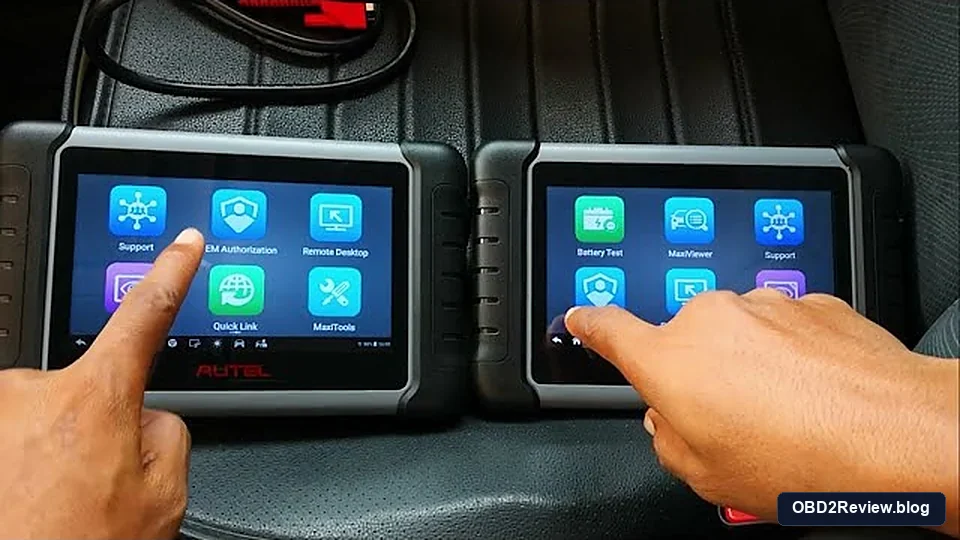
System memory configurations mirror each other precisely with standard storage capacities. Technicians experience identical boot times and smooth graphical navigation regardless of which specific tablet model they choose.
Detailing these hardware specifications, our Autel MaxiCom MK808 review highlights the quad-core processor paired with 1GB of RAM and 32GB of onboard storage for smooth graphical rendering.
The internal architecture utilizes a custom printed circuit board layout designed to dissipate thermal energy efficiently during extended diagnostic sessions, minimizing processor throttling when communicating heavy data streams across multiple vehicle electronic control units.
- Identical quad-core processing architecture ensures reliable speed.
- Shared memory allocations prevent performance bottlenecks during scans.
- Equal hardware foundations dictate identical graphical rendering capabilities.
Internal Processing Benchmarks
Evaluating raw processing power reveals no practical operational differences between units. Both devices process complex data streams smoothly using optimized Android operating systems tailored for technicians.
Memory management algorithms handle large diagnostic trouble code databases efficiently without experiencing noticeable lag or unexpected system crashes during extended daily shop deployment.
- Optimized Android OS minimizes unnecessary background resource consumption.
- Large DTC databases load quickly without noticeable operational lag.
Diagnostic Coverage and ECU Communication Protocols
As noted in our Autel MaxiCOM MX808 review, vehicle communication protocols are handled via robust OBD-II connectors supporting all standard modes with exceptional protocol depth.
Manufacturer-specific coverage varies slightly depending on regional firmware releases. Professional shops must verify specific make and model software bundles before committing to either diagnostic platform.
Hardware multiplexing inside the VCI unit supports all standard OBD2 protocols, including ISO9141-2, KWP2000, SAE J1850, and modern CAN bus architectures, ensuring seamless connectivity across domestic, Asian, and European vehicle networks manufactured from 1996 onward.
Technicians gain comprehensive access to foundational modules like powertrain, body, and chassis controllers, allowing them to read and clear generic trouble codes while executing advanced bi-directional active tests on specific actuators.
- Comprehensive support spans all ten standard OBD-II diagnostic modes.
- Advanced module access covers ABS, SRS, transmission, and engine controllers.
- Regional software packages determine ultimate vehicle make coverage depth.
Protocol Handshake Speeds
Establishing communication with stubborn vehicle control units requires fast protocol handshaking. Both scanners utilize optimized CAN bus drivers to accelerate initial vehicle identification and VIN decoding.
Auto-VIN technology quickly captures chassis information to streamline the diagnostic workflow, reducing manual entry errors inside busy, high-volume automotive repair service environments.
- Fast CAN bus drivers accelerate initial vehicle module identification.
- Auto-VIN technology eliminates tedious manual vehicle data entry steps.
Maintenance Reset Functions and Special Service Operations
Service reset capabilities represent a major purchasing factor for professional technicians. The Maxicheck series traditionally emphasizes dedicated maintenance resets like oil service lights and electronic parking brakes.
Conversely, alternative models often bundle broader diagnostic capabilities alongside standard service functions. Understanding your daily workshop requirements dictates which feature set provides optimal return on investment.
Special service operations are deeply integrated into the software interface, providing dedicated subroutines for electronic parking brake retraction, steering angle sensor calibration, and essential battery management system resets following component replacement.
Performing complex diesel particulate filter regenerations requires strict adherence to thermal safety parameters, and these diagnostic tools prompt technicians through precise pre-conditions before initiating high-temperature soot oxidation cycles safely.
- Dedicated maintenance resets target high-turnover service bay operations.
- Electronic parking brake service modes function across major global brands.
- Steering angle sensor calibration procedures execute reliably on supported platforms.
Specialized Service Function Execution
Executing battery registration and diesel particulate filter regeneration requires precise parameter handshakes. Both diagnostic tools provide clear on-screen prompts guiding technicians through complex reset procedures safely.
Error handling protocols prevent incorrect service executions by verifying pre-conditions before initiating sensitive electronic module resets or calibration routines on modern vehicles.
- Clear on-screen prompts guide technicians through complex reset sequences.
- Pre-condition checks prevent accidental errors during sensitive calibrations.
Ergonomic Footprint, Display Metrics, and Battery Endurance
Physical ergonomics directly influence daily usability during extended diagnostic troubleshooting sessions. Both tools feature a seven-inch touchscreen display housed within a durable, impact-resistant polymer casing designed for shops.
Screen brightness levels remain legible under fluorescent shop lighting, though direct sunlight can occasionally wash out fine graphical details during outdoor mobile diagnostic service calls.
The physical housing incorporates a 7-inch capacitive touchscreen with a 1024x600 pixel resolution, protected by a resilient glass panel that maintains readable contrast levels under fluorescent shop lighting or direct sunlight.
Powered by a rechargeable lithium-polymer battery, the hardware delivers approximately four to five hours of continuous diagnostic operations, easily supporting a standard technician shift before requiring a recharge via the included adapter.
- Durable polymer casings absorb accidental drops on concrete floors.
- Seven-inch touchscreens offer responsive capacitive multi-touch gesture controls.
- Ergonomic handgrips reduce fatigue during prolonged diagnostic testing sessions.
Battery Capacity and Thermal Performance
Internal lithium-polymer batteries deliver sufficient runtime for multiple complete vehicle scans. Power management systems optimize standby efficiency during intermittent shop usage throughout busy working days.
Thermal dissipation relies on passive cooling designs featuring internal heat sinks. This fanless engineering eliminates mechanical failure points while maintaining silent operation inside quiet service environments.
- Lithium-polymer batteries support hours of untethered diagnostic work.
- Fanless thermal designs ensure completely silent, maintenance-free operation.
Software Update Architecture and Subscription Models
Keeping diagnostic databases current requires regular Wi-Fi firmware updates delivered straight to the tool. Both devices utilize intuitive update management interfaces allowing seamless software downloads over standard wireless networks.
Subscription renewal costs and update frequencies dictate long-term ownership expenses for independent repair facilities. Reviewing current manufacturer policies ensures predictable operational budgeting year after year.
Firmware updates are delivered over Wi-Fi using Autel’s integrated software management system, allowing shops to download manufacturer-specific patches directly to the tablet without requiring external card readers or desktop computer synchronization.
Maintaining current diagnostic databases ensures complete coverage for newly released vehicle models and updated module coding algorithms, though expired subscriptions will not disable existing base diagnostic capabilities previously installed on the device.
- Wireless update delivery eliminates cumbersome computer cable connections.
- Intuitive download managers organize available vehicle software packages clearly.
- Regular firmware patches expand coverage for newly released vehicle models.
Data Logging and Cloud Reporting
When encountering unusual diagnostic glitches, technicians rely on insights from our Autel MaxiCOM MK808Z review. Recorded live data streams can be uploaded directly to cloud servers for technical support analysis.
Generating comprehensive pre- and post-repair diagnostic reports helps communicate vehicle health status clearly to customers, improving shop transparency and overall customer trust significantly.
- Data logging tools capture intermittent communication faults effectively.
- Cloud reporting generates professional diagnostic health summaries easily.
Workshop Durability and Environmental Resilience Testing
Automotive repair shops expose diagnostic equipment to harsh chemicals, oils, and physical impacts daily. Ruggedized outer bezels protect sensitive internal electronics from accidental workshop hazards and fluid contamination risks.
Connector pins undergo rigorous insertion testing to withstand thousands of connect and disconnect cycles without developing intermittent electrical connection failures in professional service environments.
Engineered for demanding automotive environments, the outer casing features thick thermoplastic elastomer bumpers designed to absorb moderate impacts if dropped accidentally onto concrete floors from standard bench heights.
The device seals successfully against common workshop contaminants like oil, grease, and brake fluid, although technicians should avoid exposing exposed USB ports and charging slots to excessive moisture or solvent pooling.
- Ruggedized outer bezels withstand harsh automotive fluid exposures.
- Reinforced data cable connections resist physical strain and pulling.
- High insertion-cycle OBD-II connectors ensure long-term electrical reliability.
Environmental Tolerance Parameters
Operating temperatures range from freezing morning conditions to hot summer service bays. Internal components are engineered to function reliably across extreme thermal gradients without experiencing performance throttling.
Moisture resistance coatings on internal circuit boards protect against condensation buildup when tools move between temperature-controlled offices and cold vehicle interiors.
- Wide operating temperature ranges handle unheated winter garages.
- Protective circuit board coatings prevent damage from condensation.
Selecting the Ideal Platform for Your Diagnostic Workload
Choosing between these two capable diagnostic tools ultimately depends on your specific service specialization. General repair shops benefit from the broader system accessibility found in comprehensive diagnostic platforms.
Specialized maintenance facilities focusing primarily on quick-lube and routine service operations will find streamlined efficiency in dedicated reset-oriented tool configurations designed specifically for high-turnover workflows.
Choosing between these diagnostic platforms depends primarily on your specific workshop workflow, as both models share identical internal hardware specifications and software capabilities despite carrying different branding and distribution channels.
Independent mechanics and mobile technicians can evaluate their local distributor support networks and warranty terms to determine which specific version provides the most reliable long-term investment for everyday diagnostic challenges.
- Match tool capabilities directly to your shop's core service offerings.
- Evaluate long-term software subscription costs against anticipated revenue.
- Consider technician familiarity with Autel operating interface layouts.
Final Decision Matrix for Technicians
Assess your typical daily vehicle volume and the complexity of faults encountered. Investing in the right hardware profile prevents workflow bottlenecks and maximizes productivity across every service bay.
Consulting our Autel MaxiCheck MX808 review provides hands-on clarity before purchasing your next primary diagnostic scanning instrument for professional automotive repair work, ensuring optimal diagnostic coverage and workflow efficiency.
- Analyze daily vehicle volume to determine required feature sets.
- Prioritize tools that streamline your most frequent service tasks.
Frequently Asked Questions
What are the primary differences between these two diagnostic tablets?
The main differences lie in their targeted software packages and regional marketing naming conventions. Both share identical internal hardware, but software licensing focuses dictate their ideal workshop applications.
Can both devices perform bi-directional control tests on vehicle modules?
Both models offer robust diagnostic capabilities, but advanced active testing depth can vary by software package. Always verify specific vehicle make coverage before attempting complex bi-directional testing routines.
How do software updates get delivered to the diagnostic tablets?
Updates download directly over standard Wi-Fi networks using an intuitive built-in management interface. This wireless system eliminates the need for cumbersome computer cables during routine updates.
Are these diagnostic tools suitable for professional full-time shop environments?
Both platforms feature durable polymer casings and robust hardware designed for daily professional use. They easily withstand standard workshop hazards while providing reliable system diagnostics.
Do these scanners require annual subscription renewals to keep working?
The core diagnostic functions continue operating normally even if your update subscription expires. However, renewing subscriptions is necessary to maintain access to new vehicle coverage updates.