Obd2 Scanner vs. Oscilloscope: Which Fits Your Setup Better?
Diagnostic scanners excel at fast software data retrieval, while oscilloscopes provide raw electrical signal visibility. Choosing the right tool depends entirely on your troubleshooting depth.


For rapid code reading and parameter monitoring, choose the OBD2 Scanner. When diagnosing complex intermittent network waveform anomalies, the Oscilloscope remains indispensable.
Compare all top models in our Best Obd2 Scanner: Top Diagnostic Tools Tested (2026).
Side-by-Side Breakdown
| Criteria | Obd2 Scanner | Oscilloscope | Edge |
|---|---|---|---|
| Peak Performance & Output | Instant digital diagnostic trouble code decoding | High-resolution analog waveform capture and analysis | Oscilloscope |
| Duty Cycle & Consistency | Continuous live data logging via serial streams | Real-time high-frequency electrical signal monitoring | Oscilloscope |
| Operating Noise & Vibration | Silent microprocessor-based digital signal processing | Silent analog-to-digital conversion sampling | Tie |
| Portability & Footprint | Compact handheld units with integrated OBD2 cables | Larger benchtop instruments or multi-channel scopes | Obd2 Scanner |
| Maintenance & Service Life | Requires periodic firmware updates and database renewals | Requires periodic channel calibration and probe checks | Obd2 Scanner |
| Power Requirements | Powered directly through the vehicle diagnostic link connector | Requires external power supply or isolated internal battery | Obd2 Scanner |
| Best Ideal Use-Case | General engine management faults and sensor monitoring | Complex CAN bus signal integrity and voltage drops | Oscilloscope |
Diagnostic Destinations and Network Topographies
Modern vehicle architectures require precise diagnostic equipment to isolate elusive faults across multiple integrated networks. Understanding the core differences ensures you select the optimal instrument for your specific garage workload.
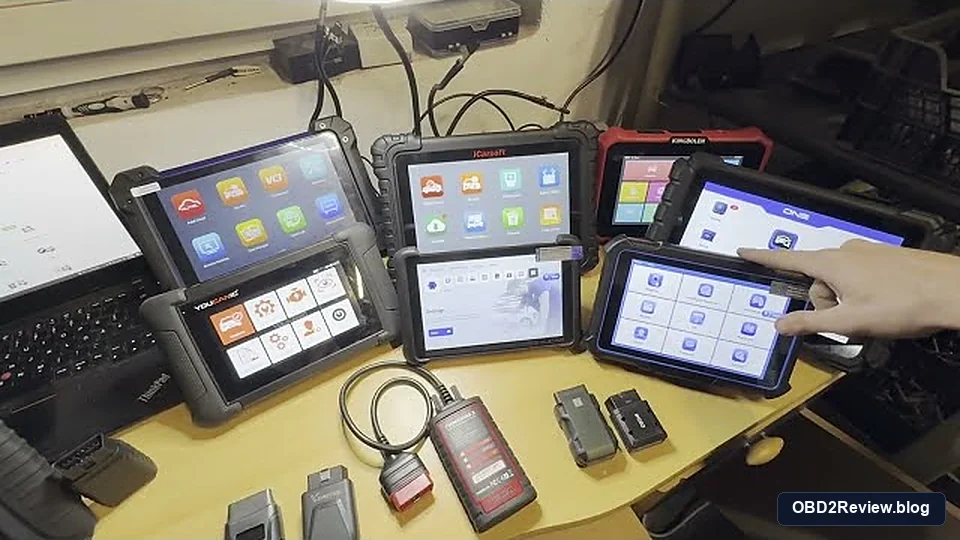
Digital scan tools communicate directly with vehicle control modules using standardized protocols. Choosing the best obd2 scanner for bmw quickly translates complex hexadecimal data into readable diagnostic trouble codes for efficient repair work.
Modern vehicle architectures rely heavily on complex multiplexed networks featuring CAN bus topologies. Technicians must understand node terminations and wiring harnesses before connecting heavy diagnostic scan tools to the DLC port.
When encountering intermittent communication drops, passive diagnostic code readers fail to capture physical layer degradation. Integrating a dual-channel digital storage oscilloscope helps visualize packet corruption, ground offsets, and impedance mismatches across distributed modules.
- Network topologies dictate your choice of diagnostic hardware.
- Control modules rely on standardized protocols for quick data translation.
- Hexadecimal data requires proper interpretation tools for effective repairs.
Navigating Complex Bus Architectures
Network layouts involve intricate wiring harnesses connecting various electronic control units throughout the chassis. Technicians must understand these pathways to effectively deploy scan tools or graphing meters.
High-speed controller area networks transmit vital data packets continuously across distinct communication lines.
- Intricate wiring harnesses connect multiple electronic control units.
- High-speed controller area networks transmit vital data packets.
Protocol Itineraries and Data Streams
Diagnostic itineraries dictate how technicians travel through a vehicle computer system during a routine troubleshooting session. Scan tools follow strict protocol roadmaps to pull stored fault codes efficiently.
Streaming live parameter identifiers allows users to observe active sensor behavior without probing physical wires. This software approach saves valuable time when addressing straightforward emission or fuel trim issues.
Automotive protocols dictate how controller area networks transmit raw messages across physical pins. Selecting the best obd2 scanner ensures rapid extraction of ISO 15765-4 parameters and hex codes for technicians.
High-speed data streams managed by advanced gateways require specialized bandwidth capabilities. While scan tools poll parameter IDs sequentially, a dedicated bandwidth oscilloscope captures every single voltage transition without missing critical bus framing bits.
- Protocol roadmaps guide technicians through computer systems.
- Streaming live parameters reveals active sensor behavior instantly.
- Software approaches save time on straightforward fuel trim issues.
Interpreting Serial Data Parameters
Serial data streams provide a wealth of information regarding engine operating conditions and sensor voltages. However, this digital data is filtered through the computer and can occasionally mask underlying hardware failures.
Understanding this limitation prevents misdiagnoses during complex electrical troubleshooting tasks.
- Serial data streams display critical engine operating conditions.
- Computer filtering can occasionally mask underlying hardware failures.
Technician Case Studies and Field Stories
Real-world field experiences highlight the distinct advantages of pairing software scanners with advanced analog testing gear. Experienced technicians rely on both instruments depending on the exact symptom presented by the vehicle.
Intermittent faults often defy simple code reading, demanding deeper electrical analysis to uncover hidden wiring resistance or corrupted reference grounds.
Consider a persistent no-start condition where trouble codes point toward an implausible fuel signal. Using the best professional obd2 scanner helps reveal a noisy 5V reference circuit corrupted by an alternator ripple.
Another common scenario involves erratic transmission shifting caused by sensor ground loops. Technicians leverage graphing multimeters or handheld scopes to measure fractional voltage drops, instantly isolating high-resistance wiring faults that software algorithms completely overlook.
- Real-world experiences highlight the need for versatile diagnostic tools.
- Intermittent faults often defy simple digital code reading.
- Deep electrical analysis uncovers hidden wiring resistance issues.
Resolving Stubborn Intermittent Faults
Intermittent glitches challenge even seasoned automotive technicians working in modern repair facilities. Documenting these elusive problems requires specialized recording capabilities found in advanced testing equipment.
Catching a momentary drop-out demands continuous signal observation.
- Intermittent glitches challenge seasoned automotive technicians daily.
- Specialized recording capabilities help capture elusive vehicle problems.
Planning Your Diagnostic Deployment Strategy
Planning your diagnostic approach before connecting tools prevents wasted time and unnecessary component replacement. Evaluate the customer complaint carefully to determine whether a software scan or a signal test comes first.
Establishing a logical workflow reduces diagnostic errors and enhances overall shop productivity significantly.
Diagnostic efficiency demands pairing the right hardware tool with the specific symptom presented by the vehicle. Shops should utilize bidirectional scan tools for initial module configuration while reserving laboratory scopes for deep electrical component verification.
Budget allocation dictates tool acquisition phases for repair facilities mastering modern automotive electronics. Equipping bays with the best budget obd2 scanner paired with a four-channel scope ensures complete coverage of complex diagnostic trees.
- Planning your approach prevents wasted troubleshooting time.
- Evaluate complaints to choose the correct primary diagnostic tool.
- Logical workflows reduce diagnostic errors across the board.
Prioritizing Tool Selection in the Bay
Choosing the right instrument depends on the system experiencing the active failure condition today. Powertrain modules usually start with a scanner, while charging systems demand direct meter testing.
Matching the tool to the fault accelerates the repair process.
- Tool selection depends on the specific system failing.
- Powertrain modules typically start with a standard code scanner.
Probing and Diving into Signal Physics
Diving deep into electrical signal physics requires an instrument capable of displaying raw voltage over time. Oscilloscopes reveal the true physical nature of electronic signals without digital computer filtering.
This capability exposes distorted waveforms, corrupted square waves, and unexpected voltage spikes that scanners completely miss.
Understanding electrical signal physics requires examining waveform rise times, amplitude, and high-frequency noise interference. When testing inductive actuators, connecting an attenuation probe protects sensitive oscilloscope channels from high-voltage inductive kickback spikes generated during operation.
Signal integrity is frequently compromised by poor shielding or improper routing near secondary ignition components. Technicians analyze waveform duty cycles and pulse-width modulation parameters to verify that control modules accurately drive fuel injectors and electronic throttles.
- Signal physics require instruments displaying raw voltage over time.
- Oscilloscopes reveal the true physical nature of electronic signals.
- Raw observation exposes distorted waveforms and voltage spikes.
Analyzing Waveform Amplitude and Frequency
Examining waveform amplitude and frequency helps verify sensor calibration and actuator response times accurately. Technicians measure specific voltage peaks to ensure components operate within strict manufacturer tolerances.
Precise measurements confirm proper circuit integrity under load.
- Waveform amplitude verification ensures accurate sensor calibration.
- Technicians measure voltage peaks against strict manufacturer tolerances.
Advanced Waveform Expeditions and Analysis
Conducting advanced waveform expeditions allows technicians to view high-speed serial communication packets visually. Multi-channel scopes decouple network nodes to isolate damaged transceiver chips or shorted wiring.
Mastering these advanced techniques elevates diagnostic competence and expands your capability to fix difficult modern cars.
Capturing sporadic electrical anomalies demands sophisticated trigger functions built into modern diagnostic testing instruments. Setting a precise edge trigger allows technicians to freeze fleeting CAN bus communication errors that standard diagnostic scanners completely fail to log.
Advanced waveform math channels enable real-time calculation of power dissipation across switching transistors and sensors. Utilizing a current clamp alongside voltage leads grants deep insight into waveform analysis without ever piercing wire insulation during troubleshooting.
- Advanced expeditions let technicians view high-speed communication packets.
- Multi-channel scopes isolate damaged transceiver chips effectively.
- Mastering these techniques elevates overall diagnostic competence.
Isolating Network Communication Breakdowns
Network communication breakdowns manifest as corrupted bus voltage levels during active data transmission phases. Scanners might only report a lost communication code, leaving the exact physical cause entirely hidden.
Visual scope analysis solves this missing link immediately.
- Communication breakdowns manifest as corrupted bus voltage levels.
- Scanners often report only generic lost communication trouble codes.
Frequently Asked Questions
Can an OBD2 scanner replace an oscilloscope entirely?
An OBD2 scanner cannot replace an oscilloscope because scanners only read digital data translated by modules. Raw electrical signals require a scope for proper analysis.
When should I choose an oscilloscope over a scan tool?
You should choose an oscilloscope when troubleshooting intermittent wiring issues or analyzing CAN bus waveforms. Signal integrity problems demand direct analog measurement.
Are oscilloscopes too difficult for beginner DIY mechanics?
Oscilloscopes have a steeper learning curve than basic plug-in code readers. Proper probe setup and timebase adjustments require foundational electrical knowledge.
Do OBD2 scanners show live sensor data streams?
Most modern OBD2 scanners display comprehensive live data parameters from engine sensors. Digital parameter IDs provide fast insight into computer inputs.
What is the primary limitation of digital diagnostic scanners?
Digital scanners rely entirely on module processing and internal software algorithms. Hidden physical faults can bypass computer detection altogether.