Ts608 vs. Mx808: Which Fits Your Setup Better?
Choosing between these diagnostic powerhouses requires balancing advanced TPMS functionality against streamlined general repair workflows. Understanding their distinct hardware capabilities ensures you invest in the right tool for your specific garage environment.


For dedicated tire shops and comprehensive technicians, the TS608 delivers unmatched sensor programming versatility. General mechanics focused purely on engine diagnostics and electronic resets will find the MX808 to be more efficient.
Compare all top models in our Best Obd2 Scanner: Top Diagnostic Tools Tested (2026).
Side-by-Side Breakdown
| Criteria | Ts608 | Mx808 | Edge |
|---|---|---|---|
| Peak Performance & Output | Quad-core processor with full system diagnostics | Quad-core processor with standard diagnostics | Tie |
| Duty Cycle & Consistency | High thermal endurance during active TPMS scans | Optimized battery life for extended code clearing | Mx808 |
| Operating Noise & Vibration | Silent solid-state operation with haptic feedback | Silent solid-state operation with standard touch | Tie |
| Portability & Footprint | Slightly heavier housing due to integrated antenna | Lighter, streamlined handheld tablet profile | Mx808 |
| Maintenance & Service Life | Regular software updates with robust sensor support | Frequent vehicle database refreshes for newer models | Ts608 |
| Power Requirements | Internal rechargeable lithium-polymer battery system | Internal rechargeable lithium-polymer battery system | Tie |
| Best Ideal Use-Case | Full service bays needing complete TPMS integration | General repair shops needing rapid code scanning | Split |
Diagnostic Architecture and Hardware Foundations
Modern automotive troubleshooting demands robust computing power inside the diagnostic tablet. Both platforms utilize responsive touchscreens and intuitive operating systems designed for rapid navigation through complex vehicle networks.
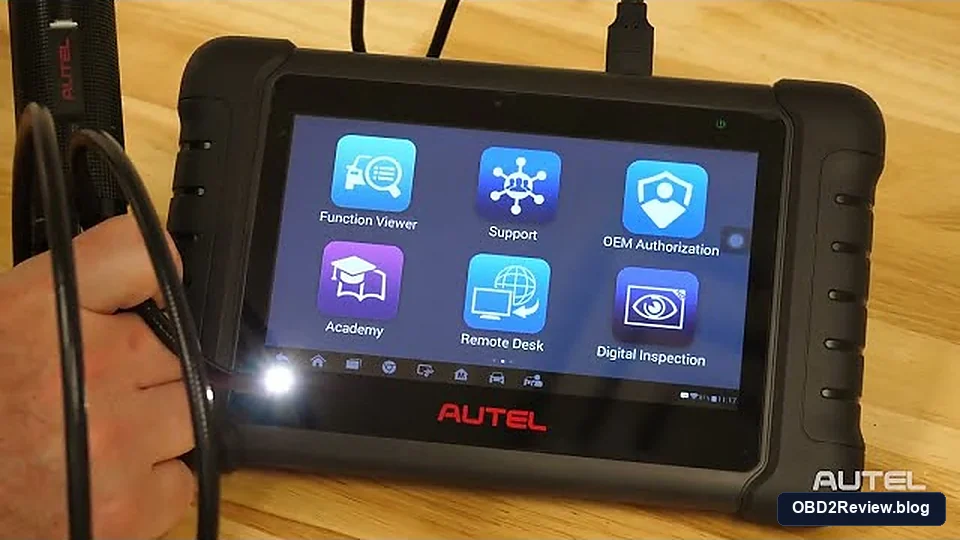
Internal processors handle live data graphing smoothly without noticeable lag during multiplex communication sweeps. Technicians benefit from clear visual layouts that display multiple parameter IDs simultaneously on screen.
Hardware durability remains a core priority for professional shop environments facing daily mechanical exposure. Protective rubber casing guards against accidental drops onto concrete service bay floors.
Building upon insights from our Autel MX808 review, the hardware utilizes a quad-core processor paired with an intuitive Android operating system to streamline routine diagnostic scans across various vehicle networks.
Conversely, the TS608 incorporates equivalent computational hardware while integrating specialized radio frequency modules to handle direct sensor communication alongside standard OBDII protocol translation, bridging mechanical troubleshooting with dedicated tire pressure monitoring systems.
Both diagnostic tools rely on solid-state internal storage configurations, ensuring fast application loading times and reliable local database retention for diagnostic trouble codes, freeze-frame data, and critical live sensor parameter streams.
- Responsive multi-touch capacitive display panels
- Standardized OBD-II diagnostic cable connectivity
- Robust internal flash memory for vehicle software
Processor Performance and Data Bus Speeds
Communication speed across high-speed CAN buses dictates overall diagnostic efficiency. Both units query module addresses rapidly to generate comprehensive health reports within seconds.
Interpreting live sensor data requires stable clock speeds to prevent dropped frames. Technicians can record and playback live parameter IDs to isolate intermittent electrical faults.
- Rapid module identification protocols
- Stable live data PID refresh rates
Comprehensive TPMS Integration Versus Standard Diagnostics
Tire pressure monitoring system service requires specialized hardware antennas built directly into the diagnostic chassis. This capability allows technicians to trigger sensors, read ID codes, and program replacements seamlessly.
Standard diagnostic tablets lack these dedicated radio frequency modules, limiting their usefulness for tire shops. Technicians must weigh whether comprehensive TPMS service justifies the heavier hardware footprint.
Sensor relearn procedures often require OBD actuation alongside physical activation tools. Having an all-in-one unit eliminates the need for carrying secondary specialized programming equipment.
As detailed in our Maxicheck MX808 review, the tool serves as a general diagnostic powerhouse, providing deep system access for engine and ABS modules while lacking direct sensor activation.
Stepping up to the TS608 introduces a fully functional TPMS service tool capable of triggering, programming, and relearning universal sensors across domestic, Asian, and European vehicle platforms without needing an auxiliary activation wand.
Technicians diagnosing intermittent tire pressure warnings alongside traditional powertrain faults will appreciate how the TS608 merges these workflows into a single interface, minimizing device swapping during busy bay schedule rotations.
- Built-in low-frequency antenna for sensor activation
- Extensive database of OE and programmable sensor parts
- Step-by-step on-screen relearn instruction guides
Evaluating Sensor Programming Workflows
Cloning old sensors onto new programmable units saves significant diagnostic time during seasonal tire changes. The programming interface guides users through successful data transfer without confusion.
Diagnosing dead sensor batteries becomes straightforward when RF signal strength is measured directly. Technicians can provide customers with printed proof of sensor failure prior to replacement.
- Direct sensor ID cloning capabilities
- Accurate battery health status reporting
Build Quality, Ergonomics, and Field Durability
Daily shop usage exposes diagnostic equipment to grease, brake fluid, and accidental impacts. Enclosure materials must resist chemical degradation while maintaining a comfortable grip for technicians.
Handheld ergonomics dictate how comfortably a mechanic can hold the tool during extended road testing. Balanced weight distribution reduces wrist fatigue when performing stationary diagnostic sweeps.
Physical button placement supplements touchscreen inputs when wearing thick shop gloves. Protective corner bumpers absorb shock forces effectively during accidental bench drops.
Both scanning tablets feature ruggedized thermoplastic housings wrapped in heavy-duty rubberized guards designed to withstand accidental drops against concrete shop floors and resist common automotive fluids like brake fluid and oil.
When evaluating the best OBD2 scanner options on the market, note that the lighter MX808 chassis significantly reduces wrist fatigue during lengthy diagnostic drive cycles compared to heavier units.
Screen legibility under direct sunlight remains adequate on both units, though technicians working outdoors should utilize anti-glare screen protectors to preserve visibility when diagnosing vehicles parked far away from workshop bays.
- Chemical-resistant outer polymer housing materials
- Integrated kickstand for hands-free diagnostic viewing
- Textured grip areas for secure handling in bays
Thermal Management and Enclosure Design
Continuous diagnostic sessions generate internal heat that must dissipate safely. Passive cooling designs prevent dust ingress while maintaining stable internal operating temperatures.
Sealed port covers protect auxiliary connection slots from airborne debris and moisture accumulation. This engineering consideration extends the operational lifespan in harsh shop environments.
- Fanless passive thermal dissipation layout
- Protected USB and charging port seals
Power Efficiency and Battery Management Metrics
Cordless diagnostic mobility relies entirely on efficient internal lithium-ion power reserves. Battery capacity must support multiple diagnostic sessions between scheduled charging cycles in the shop.
Smart power management shuts down idle circuits automatically to conserve remaining battery percentage. Technicians can rely on consistent operational runtime throughout a standard working shift.
Charging speeds via standard wall adapters minimize downtime between complex diagnostic procedures. Battery health indicators provide clear warnings before unexpected power loss occurs.
Integrated lithium-polymer battery packs supply sufficient operating time for multiple back-to-back vehicle scans, though continuous radio frequency activation on the TS608 draws considerably more current than passive OBDII code reading.
Smart power management firmware inside both diagnostic platforms automatically dims the display and enters low-power sleep modes during periods of inactivity to preserve maximum charge throughout a hectic 8-hour shift.
Recharging times via standard wall adapters are reasonably fast, but technicians must avoid depleting the internal cells completely to maintain long-term battery health and prevent premature degradation of capacity.
- High-capacity rechargeable internal battery cells
- Automated sleep modes for energy conservation
- Clear battery percentage status display icons
Optimizing Field Battery Endurance
Screen brightness adjustments significantly impact total battery longevity during mobile vehicle inspections. Lowering backlight intensity preserves power when working in dimly lit interior cabins.
Disconnecting unused wireless peripherals further reduces parasitic draw on the power supply. Maintaining proper charging habits ensures long-term battery health over years of service.
- Adjustable backlight intensity controls
- Efficient power management firmware algorithms
Diagnostic Speed, Data Bus Latency, and Processing
Translating raw vehicle network traffic into readable diagnostic trouble codes requires optimized software algorithms. Fast processing chips reduce waiting times when scanning deep module architectures.
High-speed data bus communication ensures technicians catch fleeting intermittent electrical faults instantly. Graphing tools plot voltage fluctuations with high fidelity to aid troubleshooting.
Software stability prevents frustrating application crashes during critical module coding sequences. Regular firmware updates patch known communication bugs across various vehicle makes.
Communicating with modern CAN-FD and DoIP protocols requires robust processing power to parse thousands of live data parameters without noticeable screen lag or dropped communication packets during critical system testing.
Both the MX808 and TS608 execute auto-VIN identification quickly, querying vehicle control modules to extract exact year, make, and model metadata before initiating deep diagnostic scans across all available electronic control units.
Data graphing capabilities allow technicians to monitor sensor fluctuations in real time, helping identify erratic sensor behavior that might not trigger an immediate hard diagnostic trouble code on the dashboard.
- Optimized vehicle communication protocol stacks
- High-resolution live data waveform rendering
- Stable operating system firmware architecture
Interpreting Complex Module Network Traffic
Modern vehicles utilize multiple sub-networks like LIN and CAN to route information. Diagnostic tools must parse these distinct protocols simultaneously without dropping packets.
Advanced filtering options let technicians isolate specific sensor readings from background noise. This capability streamlines root cause analysis on stubborn electronic gremlins.
- Multi-protocol network traffic parsing
- Customizable PID data filtering tools
Workflow Optimization and Service Reset Capabilities
Routine maintenance tasks demand quick access to electronic service reset functions. Oil life resets, electronic parking brake releases, and steering angle calibrations must execute smoothly.
Streamlined menu navigation reduces the clicks required to perform standard workshop procedures. Technicians appreciate shortcuts that save valuable minutes on high-volume service days.
Clear calibration instructions guide users through mandatory preliminary conditions before executing resets. This prevents failed calibration routines caused by incorrect vehicle positioning.
Comprehensive service function menus provide technicians with quick access to essential maintenance resets, including electronic parking brake retraction, steering angle calibration, oil life resets, and battery registration procedures.
For shops exploring the best Bluetooth OBD2 scanner category, the TS608 layers robust TPMS programming functions directly on top of standard resets, establishing a comprehensive workflow for technicians.
Streamlining these repetitive service tasks reduces vehicle turnaround times, allowing independent repair facilities to maximize daily bay utilization and improve overall profitability across every scheduled appointment.
- Comprehensive electronic parking brake service modes
- Accurate oil maintenance light reset procedures
- Steering angle sensor calibration routines
Executing Complex Actuation Tests
Bi-directional controls allow mechanics to command physical actuators directly from the tablet. Testing cooling fans or fuel injectors verifies component integrity without manual wiring checks.
Active test sequences provide immediate feedback regarding electronic circuit health. This direct interaction shortens the diagnostic path significantly during electrical troubleshooting.
- Direct component actuation testing protocols
- Real-time feedback on circuit response
Selecting the Optimal Unit for Your Shop Workload
Choosing between these capable diagnostic platforms depends strictly on your primary service offerings. Tire specialty shops require the dedicated sensor management hardware found on advanced models.
General mechanical repair facilities focused on powertrain diagnostics can maximize value with streamlined diagnostic tablets. Assessing your typical daily repair tickets clarifies the ideal investment choice.
Long-term software subscription costs and update frequencies should factor into your purchasing decision. Selecting a tool that matches your technical scope prevents unnecessary equipment expenditures.
Choosing between these two diagnostic tools depends entirely on your daily repair volume and whether tire service represents a core revenue stream for your specific automotive workshop environment.
General repair shops focusing primarily on mechanical diagnostics, electrical troubleshooting, and standard maintenance will find exceptional value in the streamlined, cost-effective capabilities of the Autel MX808 tablet.
Conversely, dedicated tire shops and full-service facilities handling frequent wheel replacements benefit immensely from the advanced TPMS sensor integration built natively into the rugged TS608 hardware platform.
- Align tool features with daily service requirements
- Consider future shop expansion into specialized repairs
- Evaluate software update continuation costs
Return on Investment for Professional Technicians
Investing in the correct diagnostic hardware accelerates bay turnaround times noticeably. Faster diagnosis translates directly into increased billable labor hours and higher shop profitability.
Reliable equipment minimizes diagnostic errors and prevents costly comebacks from unsatisfied clients. Quality tools become profit centers rather than mere operational expenses.
- Accelerated vehicle diagnostic turnaround times
- Minimized risk of costly diagnostic errors
Frequently Asked Questions
Can the standard mx808 program tire pressure sensors?
No, the standard model lacks the integrated radio frequency antenna required for sensor programming. You will need a dedicated TPMS tool or the upgraded variant for complete sensor service.
Are software updates required for normal daily diagnostics?
Basic OBD-II generic code reading functions work without active updates indefinitely. However, new vehicle coverage requires periodic database renewals to access proprietary module protocols.
Do both scanners support bi-directional active testing?
Yes, both platforms offer robust bi-directional control capabilities for actuating components. This allows technicians to command relays and solenoids directly during electrical fault isolation.
How long does the internal rechargeable battery typically last?
Under continuous active diagnostic usage, the battery delivers solid operational runtime. Enabling power saving features easily spans a full standard working shift in the shop.
Can these tablets print diagnostic reports directly to a printer?
Yes, both units support wireless network printing through standard computer network protocols. Technicians can generate professional health reports to hand directly to vehicle owners.